Showing posts with label apologetics. Show all posts

Sunday, December 14, 2008

Christmas and Sin: Not One Without the Other

See why here.
Deep, difficult and mysterious questions these.


Monday, April 14, 2008

The Paradoxes of Orthodox Christianity: A Romance

ALL sane men can see that sanity is some kind of equilibrium; that one may be mad and eat too much, or mad and eat too little. Some moderns have indeed appeared with vague versions of progress and evolution which seek to destroy the meson or balance of Aristotle. They seem to suggest that we are meant to starve progressively, or to go on eating larger and larger breakfasts every morning for ever. But the great truism of the meson remains for all thinking men, and these people have not upset any balance except their own. But granted that we have all to keep a balance, the real interest comes in with the question of how that balance can be kept. That was the problem which paganism tried to solve; that was the problem which I think Christianity solved and solved in a very strange way.

Paganism declared that virtue was in a balance; Christianity declared it was in a conflict: the collision of two passions apparently opposites. Of course they were not really inconsistent; but they were such that it was hard to hold simultaneously. Let us follow for a moment the clue of the martyr and the suicide, and take the case of courage. No quality has ever so much addled the brains and tangled the definitions of merely rational sages. Courage is almost a contradiction in terms. It means a strong desire to live taking the form of a readiness to die. "He that will lose his life, the same shall save it," is not a piece of mysticism for saints and heroes. It is a piece of everyday advice for sailors or mountaineers. It might be printed in an Alpine guide or a drill book.

This paradox is the whole principle of courage; even of quite earthly or quite brutal courage. A man cut off by the sea may save his life if he will risk it on the precipice. He can only get away from death by continually stepping within an inch of it. A soldier surrounded by enemies, if he is to cut his way out, needs to combine a strong desire for living with a strange carelessness about dying. He must not merely cling to life, for then he will be a coward, and will not escape. He must not merely wait for death, for then he will be a suicide, and will not escape. He must seek his life in a spirit of furious indifference to it; he must desire life like water and yet drink death like wine. No philosopher, I fancy, has ever expressed this romantic riddle with adequate lucidity, and I certainly have not done so. But Christianity has done more: It has marked the limits of it in the awful graves of the suicide and the hero, showing the distance between him who dies for the sake of living and him who dies for the sake of dying. And it has held up ever since above the European lances the banner of the mystery of chivalry: the Christian courage, which is a disdain of death; not the Chinese courage, which is a disdain of life.

And now I began to find that this duplex passion was the Christian key to ethics everywhere. Everywhere the creed made a moderation out of the still crash of two impetuous emotions. Take, for instance, the matter of modesty, of the balance between mere pride and mere prostration. The average pagan, like the average agnostic, would merely say that he was content with himself, but not insolently self-satisfied, that there were many better and many worse, that his deserts were limited, but he would see that he got them. In short, he would walk with his head in the air; but not necessarily with his nose in the air. This is a manly and rational position, but it is open to the objection we noted against the compromise between optimism and pessimism--the "resignation" of Matthew Arnold. Being a mixture of two things, it is a dilution of two things; neither is present in its full strength or contributes its full color. This proper pride does not lift the heart like the tongue of trumpets; you cannot go clad in crimson and gold for this.

On the other hand, this mild rationalist modesty does not cleanse the soul with fire and make it clear like crystal; it does not (like a strict and searching humility) make a man as a little child, who can sit at the feet of the grass. It does not make him look up and see marvels; for Alice must grow small if she is to be Alice in Wonderland. Thus it loses both the poetry of being proud and the poetry of being humble. Christianity sought by this same strange expedient to save both of them.

It separated the two ideas and then exaggerated them both. In one way Man was to be haughtier than he had ever been before; in another way he was to be humbler than he had ever been before. In so far as I am Man I am the chief of creatures. In so far as I am a man I am the chief of sinners. All humility that had meant pessimism, that had meant man taking a vague or mean view of his whole destiny--all that was to go. We were to hear no more the wail of Ecclesiastes that humanity had no pre-eminence over the brute, or the awful cry of Homer that man was only the saddest of all the beasts of the field. Man was a statue of God walking about the garden. Man had pre-eminence over all the brutes--man was only sad because he was not a beast, but a broken god. The Greek had spoken of men creeping on the earth, as if clinging to it. Now Man was to tread on the earth as if to subdue it. Christianity thus held a thought of the dignity of man that could only be expressed in crowns rayed like the sun and fans of peacock plumage.

Yet at the same time it could hold a thought about the abject smallness of man that could only be expressed in fasting and fantastic submission in the gray ashes of St. Dominic and the white snows of St. Bernard. When one came to think of one's self, there was vista and void enough for any amount of bleak abnegation and bitter truth. There the realistic gentleman could let himself go--as long as he let himself go at himself. There was an open playground for the happy pessimist. Let him say anything against himself short of blaspheming the original aim of his being; let him call himself a fool and even a damned fool (though that is Calvinistic); but he must not say that fools are not worth saving. He must not say that a man, qua man, can be valueless.

Here, again in short, Christianity got over the difficulty of combining furious opposites, by keeping them both, and keeping them both furious. The Church was positive on both points. One can hardly think too little of one's self. One can hardly think too much of one's soul.

Take another case: the complicated question of charity, which some highly uncharitable idealists seem to think quite easy. Charity is a paradox, like modesty and courage. Stated baldly, charity certainly means one of two things--pardoning unpardonable acts, or loving unlovable people. But if we ask ourselves (as we did in the case of (pride) what a sensible pagan would feel about such a subject, we shall probably be beginning at the bottom of it. A sensible pagan would say that there were some people one could forgive, and some one couldn't: a slave who stole wine could be laughed at; a slave who betrayed his benefactor could be killed, and cursed even after he was killed. In so far as the act was pardonable, the man was pardonable.

That again is rational, and even refreshing; but it is a dilution. It leaves no place for a pure horror of injustice, such as that which is a great beauty in the innocent. And it leaves no place for a mere tenderness for men as men, such as is the whole fascination of the charitable. Christianity came in here as before. It came in startlingly with a sword, and clove one thing from another. It divided the crime from the criminal. The criminal we must forgive unto seventy times seven. The crime we must not forgive at all.

It was not enough that slaves who stole wine inspired partly anger and partly kindness. We must be much more angry with theft than before, and yet much kinder to thieves than before. There was room for wrath and love to run wild. And the more I considered Christianity, the more I found that while it had established a rule and order, the chief aim of that order was to give room for good things to run wild.

Mental and emotional liberty are not so simple as they look. Really they require almost as careful a balance of laws and conditions as do social and political liberty. The ordinary aesthetic anarchist who sets out to feel everything freely gets knotted at last in a paradox that prevents him feeling at all. He breaks away from home limits to follow poetry. But in ceasing to feel home limits he has ceased to feel the "Odyssey." He is free from national prejudices and outside patriotism. But being outside patriotism he is outside "Henry V."

Such a literary man is simply outside all literature: He is more of a prisoner than any bigot. For if there is a wall between you and the world, it makes little difference whether you describe yourself as locked in or as locked out. What we want is not the universality that is outside all normal sentiments; we want the universality that is inside all normal sentiments. It is all the difference between being free from them, as a man is free from a prison, and being free of them as a man is free of a city.

I am free from Windsor Castle (that is, I am not forcibly detained there), but I am by no means free of that building. How can man be approximately free of fine emotions, able to swing them in a clear space without breakage or wrong? This was the achievement of this Christian paradox of the parallel passions. Granted the primary dogma of the war between divine and diabolic, the revolt and ruin of the world, their optimism and pessimism, as pure poetry, could be loosened like cataracts.

St. Francis, in praising all good, could be a more shouting optimist than Walt Whitman. St. Jerome, in denouncing all evil, could paint the world blacker than Schopenhauer. Both passions were free because both were kept in their place. The optimist could pour out all the praise he liked on the gay music of the march, the golden trumpets, and the purple banners going into battle. But he must not call the fight needless. The pessimist might draw as darkly as he chose the sickening marches or the sanguine wounds. But he must not call the fight hopeless.

So it was with all the other moral problems, with pride, with protest, and with compassion. By defining its main doctrine, the Church not only kept seemingly inconsistent things side by side, but, what was more, allowed them to break out in a sort of artistic violence otherwise possible only to anarchists. Meekness grew more dramatic than madness. Historic Christianity rose into a high and strange coup de theatre of morality--things that are to virtue what the crimes of Nero are to vice. The spirits of indignation and of charity took terrible and attractive forms, ranging from that monkish fierceness that scourged like a dog the first and greatest of the Plantagenets, to the sublime pity of St. Catherine, who, in the official shambles, kissed the bloody head of the criminal. Poetry could be acted as well as composed.

This heroic and monumental manner in ethics has entirely vanished with supernatural religion. Our ethical teachers write reasonably for prison reform; but we are not likely to see Mr. Cadbury, or any eminent philanthropist, go into Reading Gaol and embrace the strangled corpse before it is cast into the quicklime. Our ethical teachers write mildly against the power of millionaires; but we are not likely to see Mr. Rockefeller, or any modern tyrant, publicly whipped in Westminster Abbey.

Thus, the double charges of the secularists, though throwing nothing but darkness and confusion on themselves, throw a real light on the faith. It is true that the historic Church has at once emphasized celibacy and emphasized the family; has at once (if one may put it so) been fiercely for having children and fiercely for not having children. It has kept them side by side like two strong colors, red and white, like the red and white upon the shield of St. George. It has always had a healthy hatred of pink. It hates that combination of two colors which is the feeble expedient of the philosophers. It hates that evolution of black into white which is tantamount to a dirty gray.

In fact, the whole theory of the Church on virginity might be symbolized in the statement that white is a color: not merely the absence of a color. All that I am urging here can be expressed by saying that Christianity sought in most of these cases to keep two colors coexistent but pure. It is not a mixture like russet or purple; it is rather like a shot silk, for a shot silk is always at right angles, and is in the pattern of the cross.

So it is also, of course, with the contradictory charges of the anti-Christians about submission and slaughter. It is true that the Church told some men to fight and others not to fight; and it is true that those who fought were like thunderbolts and those who did not fight were like statues. All this simply means that the Church preferred to use its Supermen and to use its Tolstoyans. There must be some good in the life of battle, for so many good men have enjoyed being soldiers. There must be some good in the idea of non-resistance, for so many good men seem to enjoy being Quakers. All that the Church did (so far as that goes) was to prevent either of these good things from ousting the other. They existed side by side. The Tolstoyans, having all the scruples of monks, simply became monks. The Quakers became a club instead of becoming a sect. Monks said all that Tolstoy says; they poured out lucid lamentations about the cruelty of battles and the vanity of revenge. But the Tolstoyans are not quite right enough to run the whole world; and in the ages of faith they were not allowed to run it. The world did not lose the last charge of Sir James Douglas or the banner of Joan the Maid. And sometimes this pure gentleness and this pure fierceness met and justified their juncture; the paradox of all the prophets was fulfilled, and, in the soul of St. Louis, the lion lay down with the lamb.

But remember that this text is too lightly interpreted. It is constantly assured, especially in our Tolstoyan tendencies, that when the lion lies down with the lamb the lion becomes lamb-like. But that is brutal annexation and imperialism on the part of the lamb. That is simply the lamb absorbing the lion instead of the lion eating the lamb. The real problem is--Can the lion lie down with the lamb and still retain his royal ferocity? That is the problem the Church attempted; that is the miracle she achieved. This is what I have called guessing the hidden eccentricities of life. This is knowing that a man's heart is to the left and not in the middle. This is knowing not only that the earth is round, but knowing exactly where it is flat. Christian doctrine detected the oddities of life. It not only discovered the law, but it foresaw the exceptions. Those underrate Christianity who say that it discovered mercy; any one might discover mercy. In fact every one did. But to discover a plan for being merciful and also severe--that was to anticipate a strange need of human nature. For no one wants to be forgiven for a big sin as if it were a little one . . . Anyone might say, "Neither swagger nor grovel; and it would have been a limit." But to say, "Here you can swagger and there you can grovel"--that was an emancipation.

This was the big fact about Christian ethics; the discovery of the new balance. Paganism had been like a pillar of marble, upright because proportioned with symmetry. Christianity was like a huge and ragged and romantic rock, which, though it sways on its pedestal at a touch, yet, because its exaggerated excrescences exactly balance each other, is enthroned there for a thousand years. In a Gothic cathedral the columns were all different, but they were all necessary. Every support seemed an accidental and fantastic support; every buttress was a flying buttress. So in Christendom apparent accidents balanced. Becket wore a hair shirt under his gold and crimson, and there is much to be said for the combination; for Becket got the benefit of the hair shirt while the people in the street got the benefit of the crimson and gold. It is at least better than the manner of the modern millionaire, who has the black and the drab outwardly for others, and the gold next his heart.

But the balance was not always in one man's body as in Becket's; the balance was often distributed over the whole body of Christendom. Because a man prayed and fasted on the Northern snows, flowers could be flung at his festival in the Southern cities; and because fanatics drank water on the sands of Syria, men could still drink cider in the orchards of England. This is what makes Christendom at once so much more perplexing and so much more interesting than the Pagan empire; just as Amiens Cathedral is not better but more interesting than the Parthenon. If any one wants a modern proof of all this, let him consider the curious fact that, under Christianity, Europe (while remaining a unity) has broken up into individual nations.

Patriotism is a perfect example of this deliberate balancing of one emphasis against another emphasis. The instinct of the pagan empire would have said, "You shall all be Roman citizens, and grow alike; let the German grow less slow and reverent; the Frenchmen less experimental and swift." But the instinct of Christian Europe says, "Let the German remain slow and reverent, that the Frenchman may the more safely be swift and experimental. We will make an equipoise out of these excesses. The absurdity called Germany shall correct the insanity called France."

Last and most important, it is exactly this which explains what is so inexplicable to all the modern critics of the history of Christianity. I mean the monstrous wars about small points of theology, the earthquakes of emotion about a gesture or a word. It was only a matter of an inch; but an inch is everything when you are balancing. The Church could not afford to swerve a hair's breadth on some things if she was to continue her great and daring experiment of the irregular equilibrium. Once let one idea become less powerful and some other idea would become too powerful. It was no flock of sheep the Christian shepherd was leading, but a herd of bulls and tigers, of terrible ideals and devouring doctrines, each one of them strong enough to turn to a false religion and lay waste the world. Remember that the Church went in specifically for dangerous ideas; she was a lion tamer.

The idea of birth through a Holy Spirit, of the death of a divine being, of the forgiveness of sins, or the fulfillment of prophecies, are ideas which, any one can see, need but a touch to turn them into something blasphemous or ferocious. The smallest link was let drop by the artificers of the Mediterranean, and the lion of ancestral pessimism burst his chain in the forgotten forests of the north. Of these theological equalizations I have to speak afterwards.

Here it is enough to notice that if some small mistake were made in doctrine, huge blunders might be made in human happiness. A sentence phrased wrong about the nature of symbolism would have broken all the best statues in Europe. A slip in the definitions might stop all the dances; might wither all the Christmas trees or break all the Easter eggs. Doctrines had to be defined within strict limits, even in order that man might enjoy general human liberties The Church had to be careful, if only that the world might be careless.

This is the thrilling romance of Orthodoxy. People have fallen into a foolish habit of speaking of orthodoxy as something heavy, humdrum, and safe. There never was anything so perilous or so exciting as orthodoxy. It was sanity, and to be sane is more dramatic than to be mad. It was the equilibrium of a man behind madly rushing horses, seeming to stoop this way and to sway that, yet in every attitude having the grace of statuary and the accuracy of arithmetic. The Church in its early days went fierce and fast with any war-horse; yet it is utterly unhistoric to say that she merely went mad along one idea, like a vulgar fanaticism. She swerved to left and right, so exactly as to avoid enormous obstacles. She left on one hand the huge bulk of Arianism, buttressed by all the worldly powers to make Christianity too worldly. The next instant she was swerving to avoid an orientalism, which would have made it too unworldly.

The orthodox Church never took the tame course or accepted the conventions; the orthodox Church was never respectable. It would have been easier to have accepted the earthly power of the Arians. It would have been easy, in the Calvinistic seventeenth century, to fall into the bottomless pit of predestination. It is easy to be a madman; it is easy to be a heretic. It is always easy to let the age have its head; the difficult thing is to keep one's own. It is always easy to be a modernist; as it is easy to be a snob.

To have fallen into any of those open traps of error and exaggeration which fashion after fashion and sect after sect set along the historic path of Christendom--that would indeed have been simple. It is always simple to fall; there are an infinity of angles at which one falls, only one at which one stands. To have fallen into any one of the fads from Gnosticism to Christian Science would indeed have been obvious and tame. But to have avoided them all has been one whirling adventure; and in my vision the heavenly chariot flies thundering through the ages, the dull heresies sprawling and prostrate, the wild truth reeling but erect.

- G. K. Chesterton

Mormonism: The Search for the Great Apostasy

SINCE its beginning in 1830, the Mormon Church has denied any continuous historical connection with Christianity.

Mormonism's founder, Joseph Smith, claimed that in 1820 God the Father and Jesus Christ appeared to him in the woods near his home in Palmyra, New York. Jesus said that for the preceding 1700 years (give or take a century--Mormons can't say exactly) the world had been living in the darkness of a total apostasy from the gospel. This was the answer to a question young Smith had been pondering. "My object in going to inquire of the Lord was to know which of the sects was right, that I might know which to join. . . . I asked the personages who stood above me in the light, which of all the sects was right (for at this time it had never entered into my heart that all were wrong), and which I should join. I was answered that I must join none of them for they were all wrong; and the Personage who addressed me [Jesus] said that all their creeds were an abomination in his sight; that their professors were all corrupt."

Smith convinced his credulous followers, most of them simple rural folk, that he'd been chosen, in what Mormons have come to call the First Vision, to be the first post-apostasy prophet--God's hand-picked agent charged with restoring the true gospel.

Over the next several years Smith purported to have received additional revelations from "heavenly personages." He claimed that after establishing his church in Palestine, the resurrected Jesus appeared in South America to the Nephites (Jews who, Smith said, had migrated to the New World between 600 and 592 B.C.) and organized a parallel church there (3 Nephi 11-28).

The new prophet seized on Jesus' words in John 10:16 ("I have other sheep that do not belong to this fold. These also I must lead, and they will hear my voice, and there will be one flock, one shepherd") as proof of the Lord's impending South American travel plans. The exegesis might impress one unfamiliar with the New Testament, but the usual understanding is that the "other sheep" Jesus referred to were the Gentiles, to whom the gospel also was extended.

SMITH claimed the Nephite church had the same hierarchy and ordinances as its sister church in Palestine--living prophets, twelve apostles, seventy disciples--but things didn't go well for either church. Both collapsed under the weight of pagan influences, dissolving into complete apostasy.

The late Bruce McConkie, a Mormon apostle and, during his life, perhaps Mormonism's leading theologian, explained things this way: "This universal apostasy began in the days of the ancient apostles themselves; and it was known to and foretold by them. . . . With the loss of the Gospel, the nations of the earth went into a moral eclipse called the Dark Ages. Apostasy was universal. . . . [T]his darkness still prevails except among those who have come to a knowledge of the restored Gospel."(Bruce McConkie, Mormon Doctrine (Salt Lake City: Bookcraft, 1966 ed.), 43-44. McConkie, ever pugnacious when his religion was at stake, made it clear that the Catholic Church was the wholly corrupt phoenix which rose from the ashes of Christ's failed Church. "Iniquitous conditions in the various branches of the great and abominable church in the last days are powerfully described in the Book of Mormon (2 Nephi 28; Mormon 8:28-38; Doctrine and Covenants 10:56). It is also to the Book of Mormon to which we turn for the plainest description of the Catholic Church as the great and abominable church. Nephi saw this 'church was most abominable above all other churches' in [his] vision. He 'saw the devil that he was the foundation of it,' and also the murders, wealth, harlotry, persecutions, and evil desires that historically have been part of this satanic organization. He saw that this most abominable of all churches was founded after the day of Christ and his apostles; that it took away from the gospel of the Lamb many covenants and many plain and precious parts; that it had perverted the right ways of the Lord; that it had deleted many teachings from the Bible; that this church was the mother of harlots; and that, finally, the Lord would again restore the gospel of salvation" (ibid., 1958 ed., 314-315). In recent years the Mormon Church has engaged in a strenuous public relations program designed to garner for itself acceptance as a mainstream "Christian" denomination. Anti-Catholic comments such as McConkie's, although de rigeur among Mormon apologists in the past, are no longer allowed in official Mormon works.)

Mormons believe the church Jesus established in Palestine, before its disintegration, was identical to the Mormon Church of today, with ceremonies such as baptism for the dead, a polytheistic concept of God (including eternal progression, the notion that God was a man who evolved into a god and that worthy Mormon males can evolve into gods), and other peculiarly Mormon beliefs. The fact that no historical evidence exists to corroborate this position doesn't put much of a dent in the average Mormon's mental armor.

A chief reason is the devotion Mormons have for Joseph Smith. They hold he was God's mouthpiece. His "revelations" came directly from God. This belief points to Mormonism's weak point. If you can demonstrate to a Mormon that Smith was wrong about the great apostasy, Mormonism crashes down in a heap. If Smith was wrong about this point, he could not have been a true prophet of God, and Mormonism loses its basis (The Bible has strong words to say about false prophets in Deuteronomy 13:2-6 and 18:20-22.)

If Smith was right about an apostasy, then Jesus was a pathetic failure when it came to establishing his Church. After all, what are we to think of his promises? If there really was a complete apostasy, how do we explain our Lord's claim that his Church never would be overcome, "Upon this rock I will build my Church, and the gates of hell shall not prevail against it" (Matt. 16:19)? What about his promise that he would be with his Church until the end of time (Matt. 28:20)? What about his promise to send the Holy Spirit as a guide who would abide with the Church (John 14:16, 26)? What about the Holy Spirit guiding the Church into all truth (John 16:13)?

A key difficulty for Mormons is that they can't say exactly when the apostasy took place, nor can they point to any definitive historical evidence of it. Other than Smith's claims there is only an interior feeling or testimony on which Mormons can base their beliefs, but such subjective proof proves nothing.

THERE are only a few choices: (1) Jesus' words in the passages just cited were misreported; (2) Jesus did in fact say these things but didn't really mean them--at least not in the way they had been understood by Christians for the first eighteen centuries; (3) Jesus was a liar, or (4) Joseph Smith was wrong and Jesus meant what he said.

Mormonism's claim to be the "restored" church hangs upon there having been a complete apostasy. The late James E. Talmadge, prolific Mormon writer and member of the Quorum of the Twelve Apostles, wrote, "The Church of Jesus Christ of Latter-day Saints proclaims the restoration of the Gospel, and re-establishment of the Church as of old, in this, the dispensation of the fullness of times. Such restoration and re-establishment, with the modern bestowal of the holy priesthood, would be unnecessary and indeed impossible had the Church of Christ continued among men with unbroken succession of priesthood and power, since the meridian of time [the time of Christ].

"The restored Church affirms that a general apostasy developed during and after the apostolic period, and that the primitive Church lost its power, authority, and graces as a divine institution, and degenerated into an earthly organization only. The significance and importance of the great apostasy, as a condition precedent to the re-establishment of the Church in modern times, is obvious. If the alleged apostasy of the primitive Church was not a reality, the Church of Jesus Christ of Latter-day Saints is not the divine institution its name proclaims"(James E. Talmadge, The Great Apostasy (Salt Lake City: Deseret Books, 1968 ed.), iii. For a discussion of apostolic succession see Warren H. Carroll, The Founding of Christendom and The Building of Christendom (Front Royal: Christendom College Press, 1985, 1987).) (emphasis added).

TALMADGE is correct in evaluating the consequences, of course: if no apostasy, no restoration, and if no restoration, no Mormonism.

Mormons misconstrue the biblical passages which do refer to a "great apostasy" from the Christian Church. They read into the text a complete apostasy. Scripture mentions an apostasy in Matthew 24:4-12; Mark 13:21-23; Luke 21:7-8; Acts 20:29-30; 2 Thessalonians 2:1-12; 2 Timothy 3:1-7, 4:1-4; 2 Peter 2:1-3; and Jude 17-19. Most of these verses say "many" will fall away, and not one mentions a complete apostasy of the Church. Another complication for Mormons is that these verses say the apostasy will take place at the end times, the "latter days" as the King James version renders it. The second and third centuries were not the "latter days."

The next time you encounter the apostasy argument, ask the Mormon to read the entire context of whatever verse he's quoting and show you where the writer mentions a complete apostasy. Usually he'll claim a complete apostasy was the intent of the writer and that it's at least implicitly taught in the Bible.

The best way to refute this charge is to have the Mormon read Jesus' promises regarding the doctrinal integrity and the temporal perpetuity of his Church: "On this rock I will build my Church, and the gates of hell shall not prevail against it" (Matt. 16:18); "Behold, I will be with you always, even until the end of the world" (Matt. 28:20); "The Father . . . will give you another Advocate to be with you always" (John 14:16); "The Advocate, the Holy Spirit that the Father will send in my name, he will teach you everything and remind you of all I have told you" (John 14:26); "But when he comes, the Spirit of truth, he will guide you to all truth" (John 16:13). Go through each text, pointing out that none mentions a complete apostasy.

LOOK also at the many New Testament verses which speak of the Church as Christ's own body, such as Romans 12:1-5; 1 Corinthians 12:12-27; Ephesians 3:4-6; 5:21-32; and Colossians 1:18. Since Christ is the mind and head of his Church (Eph. 4:15-16), animating the body, the members enjoy an organic spiritual union with him (John 15:1-8). It's inconceivable that he would permit his body to disintegrate under the attacks of Satan. The apostle John reminds us that Jesus is greater than Satan (1 John 4:4)(1 Timothy 3:15 describes the Church as "The household of God . . . the pillar and foundation of truth." In light of this, we find additional assurance that the house that Jesus built will not be pillaged by Satan. "No one can enter a strong man's house to plunder his property unless he first ties up the strong man. Then, he can plunder his house" (Mark 3:27; cf. Matt. 12:29). Jesus is the "strong man" guarding his household, the Church.)

Although, tragically, the gates of hell can and do prevail over individual Christians who succumb to mortal sin and cut themselves off from life-giving union with Christ (Rom. 11:22; Gal. 5:4; 2 Peter 2:20-22; 1 John 5:16-17), they can't prevail against the Church Jesus built on the rock of Peter.(Jesus didn't command his followers to do things he himself couldn't do. "Everyone who listens to these words of mine and acts on them will be like a wise man who built his house on a rock. The rains fell, the floods came, and the winds blew and buffeted the house. But it did not collapse; it had been set solidly on a rock" (Matt. 7:24- 25). It was no coincidence that Jesus used the words, "on this rock I will build my Church and the gates of hell shall not prevail against it" (Matt. 16:18; Luke 6:46-49). See also Hebrews 11:10 and 1 Peter 2:6-8.) If they could--if they did--Jesus is made to look foolish for having taught, "Which of you wishing to construct a tower does not first sit down and calculate the cost to see if there is enough for its completion? Otherwise, after laying the foundation and finding himself unable to finish the work the onlookers should laugh at him and say, 'This one began to build but did not have the resources to finish'" (Luke 15:28-30).

Consider another of Jesus' promises: "I will ask the Father and he will send you another Advocate to be with you always, the Spirit of truth, which the world cannot accept, because it neither sees nor knows it. But you know it, because it remains with you, and will be in you. I will not leave you orphans" (John 14:16-18). If Mormons are right about a complete apostasy, Jesus did leave us orphans--for 1700 years!

One thing Catholics should never do is try to avoid the fact that there have been immoral and heterodox members in the Church. Jesus didn't promise that the Church wouldn't be menaced by immorality and heterodoxy. Rather, he promised that the wheat and chaff (good and evil) would be side by side in the Church until the end (Matt. 13:24-43, 47-50).

IN a recent written exchange,(This Rock(July 1991), 18.) Mormon apologist Robert Starling, attempting to prove the divine origin of the Mormon Church, cited the Rabbi Gamaliel's prediction regarding the New Testament Church: "[I]f this endeavor or this activity is of human origin, it will destroy itself. But if it comes from God, you will not be able to destroy them; you may even find yourselves fighting against God" (Acts 5:38-39). Starling unwittingly undercut his own claim of a great apostasy. Gamaliel was right. The Church Jesus built could not be destroyed.(For a full-length examination of this issue see the two hour video-taped debate, A Catholic-Mormon Dialogue (Patrick Madrid vs. Gary Coleman, 1989), available from This Rock). This was the first-ever debate between a Catholic apologist and an official representative of the Church of Jesus Christ of Latter- day Saints.

In refuting Mormonism's theory of a complete apostasy (and in the process Mormonism itself), Catholics should be able to explain how the integrity of the Church was preserved. The answer: apostolic succession, the unbroken continuum of apostolic authority transmitted via the office of bishop. This doctrine is the logical and scriptural alternative to the Mormon concept of an apostasy and restoration.

JESUS bestowed a unique authority on the twelve apostles. He conferred on them his power to bind and loose in heaven and on Earth (Matt. 18:18). He gave them his authority to forgive sins (John 20:21-23; 2 Cor. 5:18-20). He designated Peter as his vicar, giving him a special authority to govern the Church (Matt. 16:18-19; John 21:15-17). He promised the apostles that when they taught, he spoke through them, and that whoever rejected their teachings rejected Jesus himself (Matt. 10:40; Luke 10:16).

As the Church got off the ground, the apostles transmitted this authority to their successors (Acts 1:15-26). Paul exhorted a newly-ordained bishop, "Do not neglect the gift you have, which was conferred on you by the prophetic words with the imposition of hands [ordination] of the presbyterate" (1 Tim. 4:14).

Later Paul reminded Timothy that the conferral of apostolic authority was not to be handed on to others without prudent consideration of a candidate's qualifications: "As for the imposition of hands, do not bestow it inconsiderately" (1 Tim. 5:22).

Apostolic succession can be seen in early Christian writings outside the New Testament. Around A.D. 80 Clement, a disciple of Peter and his third successor as bishop of Rome, in his letter to the Corinthians, expounded on many doctrines, including auricular confession, monotheism (Mormons claim the early Church believed in a "plurality of gods" and eternal progression), the ordained priesthood, and apostolic succession.

One of Clement's most telling lines is this: "Our apostles too were given to understand by our Lord Jesus Christ that the office of bishop would give rise to intrigues. For this reason, equipped as they were with perfect foreknowledge, they appointed the men mentioned before and afterward and laid down a rule once for all to this effect: When these men [bishops] die, other approved men shall succeed to their sacred ministry."

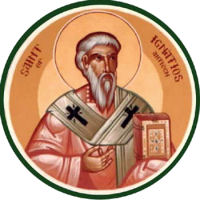
In A.D. 110, Ignatius, bishop of Antioch and disciple of the apostle John, while on his way in chains to Rome to be martyred for the faith, composed letters to six major centers of Catholicism along his route (Ephesus, Magnesia, Tralles, Philadelphia, Smyrna, Rome). Ignatius provides us with valuable insights into the doctrines and practices of the Christian Church at the close of the first century--only one generation removed from the time of Christ. His writings make it clear that the early Church was thoroughly Catholic.

His letters contain a recurring exhortation to remain in communion with the bishops who are successors to the apostles:

"Be eager, therefore, to be firmly grounded in the precepts of the Lord and the apostles, in order that whatever you do you may prosper, physically and spiritually in faith and love, in the Son and the Father and in the Spirit . . . together with your most distinguished bishop and that beautifully-woven spiritual crown which is your presbytery and the godly deacons. Be subject to the bishop and to one another" (Letter to the Magnesians 13:1-2).

Another Church Father, Irenaeus, bishop of Lyons, explained in A.D. 180, "It is possible, then, for everyone to know the truth, to contemplate the tradition of the apostles which has been made known throughout the whole world. And we are in a position to enumerate those who were instituted bishops by the apostles and their successors [down] to our own times; men who neither knew nor taught anything like these heretics rave about.

"Since it would be too long to enumerate in such a volume as this the succession of all the churches, we shall confound all those who, in whatever manner, whether through self-satisfaction or vainglory or through blindness and wicked opinion, assemble other than where it is proper, by pointing out here the successions of the bishops of the greatest and most ancient church known to all, founded and organized at Rome by the two most glorious apostles, Peter and Paul, that church which has the tradition and the faith which come down to us after having been announced to men by the apostles. With this church, because of its superior origin, all churches must agree--all the faithful in the whole world--and it is in her that the faithful everywhere have maintained the apostolic tradition" (Against Heresies, 3, 3:1-2) (For a thorough treatment of early Church writings see William Jurgens' three-volume Faith of the Early Fathers (Collegeville: Liturgical Press, 1970) and Johannes Quasten's four-volume, Patrology (Westminster, Maryland: Christian Classics, 1986). The best available critique of Mormonism, including the First Vision, is found in Jerald and Sandra Tanner's Changing World of Mormonism (Chicago: Moody Press, 1980).)

THE Mormon Church simply has no convincing answer to the ocean of biblical and historical evidence of which this is just a drop. All of it contradicts the complete apostasy theory. Yet there's another problem with the theory: the problem of silence. There's no evidence of any outcry from first or second century "Mormons" denouncing the introduction of "Catholic heresies."

Mormons might respond that, since Catholics gained the upper hand in the struggle for control of the true Church, they simply expunged any trace of the Mormons--a comforting but unviable argument. We have records of many controversies that raged in the early days of the Church (we know in great detail what turmoil the early Church passed through as it fought off various threats to its existence), and there just is no evidence--none at all--that Mormonism existed prior to the 1830's.

It's unreasonable to assume the Catholic Church would allow the survival of copious records chronicling the history, teachings, and proponents of dozens of other heresies, but would entirely destroy only the records of early Mormonism.

If Mormons want their claim of a complete apostasy to be taken seriously, they must evince biblical and historical evidence supporting it. So far they've come up empty-handed. Honest investigators will see the unavoidable truth: The Mormon "great apostasy" doctrine is a myth. There never has been--nor will there ever be--a complete apostasy. Jesus Christ promised that his Church, established on the solid rock of Peter, will remain forever. We have his Word on it.

- Patrick Madrid