Showing posts with label modernism. Show all posts

Thursday, January 22, 2009

Catholics, Monarchists and Nazis

It is no secret Catholics have an appreciation for monarchy (since they have an appreciation for liberty). What has that appreciation meant in relatively modern - that is, anti-royalist - times? Well, in Nazi Germany it meant this:

Percentage of Nazi votes, July 31, 1932:


Percentage of Catholics in Germany, 1934 census results:


Looks like the anti-Monarchist Nazis didn't fair too well with the monarchist-friendly Catholics.


Tuesday, June 24, 2008

Where Have All The Protestant Colleges Gone?

George M. Marsden explores that question as well as anyone here.

Bad Things to Little People

The taxpayers of California are paying for a multibillion-dollar Institute for Regenerative Medicine, which specializes in embryonic stem cell research and other cutting-edge technology of the brave new world. Alan Trounson heads up the project and says in an interview that he was at first “very uncomfortable” about dissecting human embryos. But then, on a trip to Naples, he talked with “members of a Vatican ­university [who] persuaded me that if I felt what I was doing was designed to address some problem of human misery, then it was acceptable" (sure). He means well, so that’s all right then. Too bad about the very little human beings, but you have to look at the big picture. Says Trounson: “In a big-picture sense, I want to be up on the mountain looking down on the Serengeti, watching all the animals move through.” You may remember Orson Welles in The Third Man, standing at the top of the ferris wheel, watching all the people moving through the square below, and explaining why this is the perspective in which to judge his dealing in diluted penicillin. When you’re doing bad things to little people, keeping the big picture in mind is a moral comfort.

Monday, June 23, 2008

Patent Pending

Last month I posted on a dangerous idea for the use of technology: it was in the form of an imaginary timeline. It may not be too imaginary if the J. Craig Venter Institute gets its way: "The bacteria could be released in the upper atmosphere, absorbing carbon dioxide in the battle against global warming."

Still scary what we are trying to do with our big dumb ideas.

Saturday, May 31, 2008

What's So Dangerous About Technology

Embracing some technology wholeheartedly is not in the best interest of anyone. To illustrate, imagine how we might explain to someone from a different timeline - someone from Earth but for whom there was no World War II - what happened in the 20th century (and beyond):

In your timeline, 1940 does not hold much significance: in our timeline the significance is almost unprecedented. In your 1940, Germany invaded France but was defeated at the Ardennes. The war was over by the end of the year. But in our timeline, Germany invaded France with staggering success. By the end of 1940, there were very few places in Europe and North Africa that the German army hadn't occupied. By the end of 1941, the Japanese had joined forces with the Nazis. They launched a "surprise" attack on America, turning the whole conflict into a global conflict. It was mechanized warfare on a scale the world had never seen before. It lasted until 1945. The allies won, but the cost was considerable. By the time the war was over, the world was a completely different place. We'd let too many genies out of too many bottles.

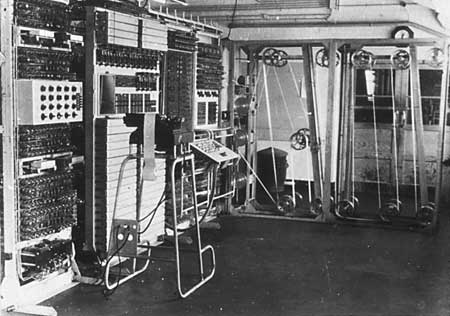
The Germans developed high-altitude rockets to bomb London. Within a couple of decades, the same technology would put people on the moon. The Americans developed atomic bombs that were used to flatten Japanese cities in a single strike. Within a couple of decades, those bombs had become powerful enough to wipe out humanity many times over, in less time than it takes to make breakfast. Then there were the computers. You know about Enigma machines. They played a significant role in wartime cryptography. But the allies built bigger, faster machines to crack the Enigma messages (the Enigma cipher was first broken, not by the US in the 1940s as our history textbooks triumphantly suggest, but rather by a group of Polish mathematicians in December, 1932). Those machines filled entire rooms and drank enough power to light up an office block. But they became smaller and faster: much smaller and much faster. They shrank down to the point where you could barely see them. Valves became transistors, transistors became integrated circuits, integrated circuits became microprocessors and microprocessors became quantum optic processors . . . and still it snowballed. Within a few decades, there was no aspect of living that hadn't been touched by computers. They were everywhere, so ubiquitous that you almost didn't notice them any more. They were in our homes, in our animals, in our money, even in our bodies. And even that was just the beginning. Because by the beginning of the 21st century, some people were not content with just having very small machines that could process a lot of data very quickly. They wanted very small machines that could process matter itself: move it around, organize and reorganize it on a microscopic scale. It was eventually proposed that these nanomachines could fix the climate: "Smart Weather" they called it.

"Big Dumb Idea" might be a better name for it. It is going to solve all our problems. Weather we could turn on and off, weather we could boss around. Proposals to seed the oceans and the upper atmosphere with tiny floating machines: invisible to the eye, "harmless" to people. Unthinkable numbers of them that are self-replicating.

Unthinkable numbers of self-replicating machines dumped into the atmosphere and oceans, supposedly under our control.

Need I say more? I think our imaginary friend from a different timeline might think all this a big dumb idea: so why not those who propose this nonsense? If it's not a nuclear holocaust from aggression, it might well be a nanomachine holocaust from compassion: either way not much left to leave to our children.

Even a nano-Bible? I mean really:


Wednesday, May 7, 2008

On TV Advertisments

Sunday, January 20, 2008

On Dogmas

Every man in the street must hold a metaphysical system, and hold it firmly. The possibility is that he may have held it so firmly and so long as to have forgotten all about its existence. This latter situation is certainly possible; in fact, it is the situation of the whole modern world. The modern world is filled with men who hold dogmas so strongly that they do not even know that they are dogmas.

- G. K. Chesterton

Friday, October 19, 2007

Saturday, October 6, 2007

Chesterton for the Day III

For most people there is a fascinating inconsistency in the position of St. Francis. He expressed in loftier and bolder language than any earthly thinker the conception that laughter is as divine as tears. He called his monks the mountebanks of God. He never forgot to take pleasure in a bird as it flashed past him, or a drop of water as it fell from his finger; he was perhaps the happiest of the sons of men. Yet this man undoubtedly founded his whole polity on the negation of what we think of the most imperious necessities; in his three vows of poverty, chastity, and obedience he denied to himself, and those he loved most, property, love, and liberty. Why was it that the most large-hearted and poetic spirits in that age found their most congenial atmosphere in these awful renunciations? Why did he who loved where all men were blind, seek to blind himself where all men loved? Why was he a monk and not a troubadour? We have a suspicion that if these questions were answered we should suddenly find that much of the enigma of this sullen time of ours was answered also.

- ST. FRANCIS OF ASSISI: 'Twelve Types.'


Saturday, September 8, 2007

Tuesday, February 6, 2007

Tragedy of the Moderns

On tragedy, from William F. Lynch's classic Christ and Apollo: "It is my deep conviction that the literary imagination, as it has been used in the theory and making of modern tragedy, has been "dishonest." It knows quite well, as we all do, that tragedy, when it is really achieved, produces an extraordinary impact of beauty and exaltation in the spectator. My own conclusion is that this achievement of tragedy has always occurred when the dramatic text has allowed itself to move through human time to the very last point of human finitude and helplessness. Here we have once again a form of the remarkable human law . . . that a kind of infinite is reached by marching through a finite. It might be put this way, somewhat paradoxically but truly, according to the feeling and actuality of great tragic texts: in tragedy a spectator is brought to the experience of a deep beauty and exaltation, but not by the way of beauty and exaltation. This is indeed . . . a natural mystery, understandable to the deep, experiential intelligence but not to the purely rational intelligence.

But the terms of this situation (and the textual facts) have been completely switched around by very many of the theorists and playwrights of our day. Apparently quite incapable of believing that anything good (much less beauty and exaltation) can come out of so enslaving a thing as the limited finite, the narrow gates of human helplessness, they have insisted, both as critics and writers, that exaltation must come out of exaltation, that infinites must come out of infinites. They therefore do a very dishonest thing . . . because they proclaim, against all the evidence, that the achievement of great tragedy has always been rooted in mystical conquests of the human spirit over pain, in the emergence of godlike strength and qualities in man in the very midst of tragic defeat. The tragic figure is really an exalted conqueror."

"A God on a Cross, that is all my theology."